Have you ever experienced this moment of despair: full of hope, you buy a bark collar for your husky, who loves to howl, and carefully put it on according to the instructions. When it starts its signature “moonlight howl” again, the collar beeps as expected, but your dog just tilts its head as if nothing happened and continues its personal concert.

You might think the product is ineffective, but in 90% of cases, the bark collar isn’t broken; its signal is simply completely blocked by your pet’s heavy, luxurious fur coat.

For breeds with dense double coats, such as Huskies, Golden Retrievers, or German Shepherds, traditional methods of wearing the bark collar are destined to be futile.

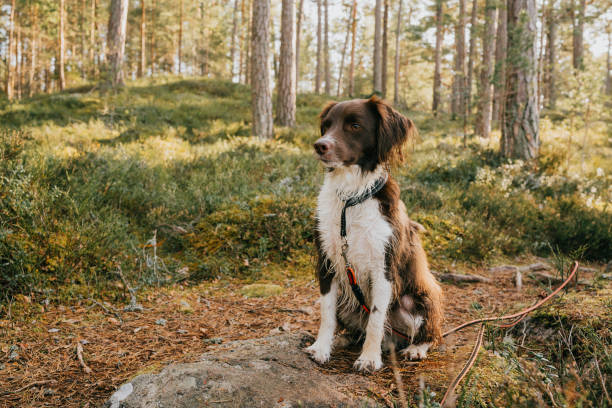
Brown and white dog sitting calmly in a forest, benefiting from a quiet bark collar.

Impedance traps reveal why your device fails on a long-haired dog.

To solve a problem, you must first understand your opponent. The fur of long-haired and thick-haired dogs is not just a tool for keeping warm; it is actually an extremely perfect insulator.

Most large working dog breeds have a “double coat.” The outer layer consists of coarse guard hairs that are waterproof and stain-resistant, while the inner layer is an extremely dense undercoat that helps retain body heat.

When air is trapped within this dense undercoat, it creates a physical barrier between the skin and the outside world.

A bark collar is a closed circuit. Whether it’s a vibration alert or a static shock, both metal contacts (prongs) must simultaneously make direct contact with the dog’s skin.

Even a millimeter or two of down in between will break the circuit. Your device is indeed working hard, but all the energy dissipates into the air, and the sensation transmitted to the dog’s skin is almost zero.

It’s like trying to listen to a classical music concert while wearing heavy, noise-canceling earmuffs.

the huskyTherefore, when you find that the bark collar for husky doesn’t seem to have any effect, don’t doubt the quality of the chip; what you need to check is the physical contact surface.

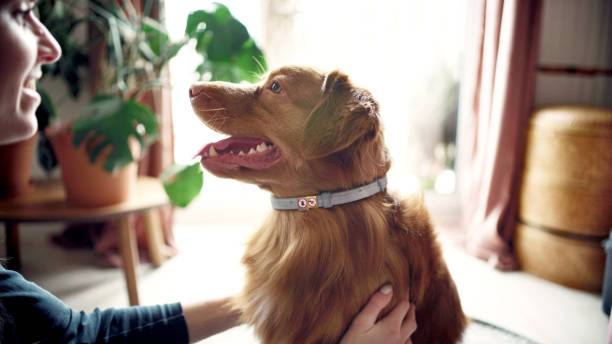
Happy golden retriever with a collar being petted, perfect for bark collar training.

Why Long Prongs Bark Collar is Key in Hardware Selection

One of the first mistakes many new owners make is insisting on using the accessories that come pre-installed in the box. Most bark collars come with short points (usually about 3/8 inch long) by default, which is more than enough for short-haired hounds, pit bulls, or Dobermans.

However, for Golden Retrievers or German Shepherds, this is like trying to pierce a thick sponge with a short toothpick.

-prongedIn this situation, a long prongs bark collar becomes the key to breaking the deadlock.

The long contact points (typically between 5/8 inch and 3/4 inch in length) are specifically designed to penetrate the double coat. They act like comb teeth, cutting deeper into both the outer guard hairs and the inner downy hairs, reaching the skin surface.

Core standards for selection and use:

  • Rounded corners: The tips of high-quality long contact points must be rounded, not sharp, to prevent pressure sores on the dog’s neck.
  • Conductive silicone cap: More advanced bark collars on the market now come with an extended conductive silicone cap. This not only provides the necessary length but also filters out the harshness of metal, greatly improving wearing comfort. If you’re looking for such a device, it’s crucial to check if the accessory pack includes specially designed contacts for thick-haired dogs.
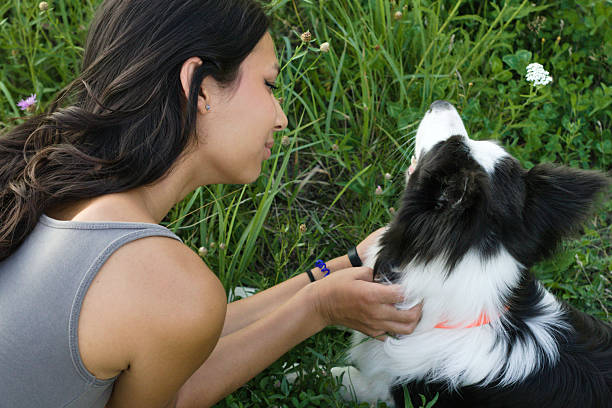
Woman petting a focused black and white dog in a field, considering a bark collar.

Wearing and preparing for how to create the perfect conductive channel for a thick-haired dog

Owning a long-pronged bark collar is just the first step; the correct wearing method and prior preparation are the watershed moments that determine success. It’s not as simple as just fastening the buckle.

The Fur-Parting Technique

When putting a bark collar on a thick-haired dog, never press the collar directly onto the fur. Instead, like a hairdresser finding a hairline, use your hands to part the fur to the sides where the dog’s vocal cords are located (straight below the throat), exposing a clear “skin channel.”

Then, press the bark collar‘s contact points directly onto the skin and tighten the strap.

Strategic trimming (Shaving Dog Neck for Shock Collar)

For breeds like Alaskan Malamutes or certain Huskies with extremely thick coats, simply plucking their fur may not be enough. In these cases, we need to resort to more professional methods: shaving the dog’s neck for a shock collar.

There’s a huge misconception in the industry: many people believe that this requires shaving all the hair off a dog’s neck, leaving it bare. This is absolutely wrong.

Not only is it unsightly, but it also leaves the dog vulnerable, increasing the risk of skin diseases.

Correct operating procedure:

  1. Positioning: Locate the exact position where you will wear the collar (wear it high on your neck, close to your jawline).
  2. Thinning, not shaving: Use professional pet grooming thinning shears or the long calipers of hair clippers to “thin” only the two coin-sized areas at the contact point.
  3. Objective: Your goal is to remove the dead, conductive fuzz that hinders electrical conductivity, allowing the contact points to easily reach the skin while retaining the outer guard hairs. When the dog removes the collar, there should be no visible signs of trimming.

Tightness test

For a bark collar for thick fur, the collar must be tighter than a regular dog-walking collar.

The standard is you should only be able to barely fit one finger under the collar. If you can slide two fingers under the collar, the contact point will slide on the thick fur, thus losing contact with the skin.

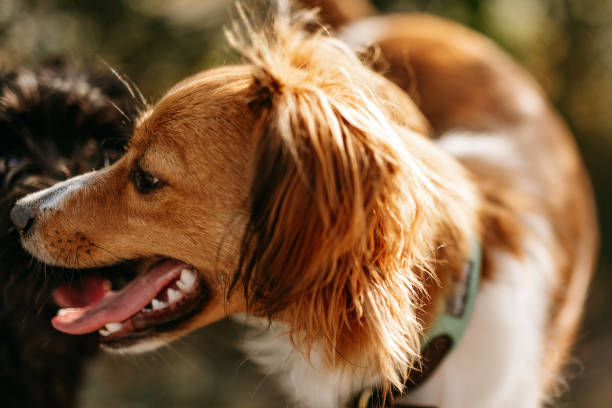
Close-up of a happy brown and white dog with a collar, ideal for a bark collar.

The intensity test was conducted on the vibration and static electricity settings for thick-haired dogs.

After optimizing the hardware and wearable components, we moved on to the most crucial training phase: finding the “working level.”

Thick-haired dogs typically have a more unique sensitivity to stimuli. Because the cushioning effect of their fur still exists (making 100% perfect skin-to-skin contact difficult), they may need a higher initial setting than short-haired dogs.

However, this doesn’t mean you should immediately switch to the highest setting.

Scientific testing process:

  1. Start with the vibration mode: First, use high-frequency vibration to test the fit of the contact points. If the long-haired dog scratches its neck, shakes its ears, or stops barking when the collar vibrates, it indicates a good connection.
  2. Finding the perception baseline: If using electrostatic cues, start testing from the lowest level (Level 1). When you increase to a certain level, if the dog only blinks slightly, twitches its ears, or looks around, it means they have perceived the cues, and that’s the perfect “working level.”
  3. To avoid overreaction: Because the bark collar for huskies often needs to penetrate thick fur, the conduction of the current can be very rapid once the contact point successfully contacts the skin. Therefore, be sure to increase the intensity in very small increments (one level at a time) to avoid startling your dog with sudden increases in stimulation.

The limits of tools and the wisdom of their owners

In this interconnected world, pet assistance tools are constantly evolving. But no matter how intelligent Bark Collar‘s chip is, it still needs to adhere to the fundamental laws of physics.

For owners of long-haired and thick-haired dogs, the key to success lies in breaking the illusion of a “one-and-done” solution. Understanding how to use a long-haired bark collar, mastering the fine motor skills of using a dog’s neck for a shaving shock collar, and patiently finding the optimal setting are the real secrets to turning an “ineffective product” into a valuable asset.

Tools are merely a medium for you to communicate with your dog; your patience and scientific approach are the ultimate solutions to calm them down.


FAQ

Will shaving my dog’s neck for a shock collar damage my Husky’s coat permanently?

No, provided that a “thinning” rather than “shaving” strategy is used. Double-coated dogs naturally shed and grow their undercoat seasonally. As long as the hair follicles are not damaged and the outer guard hairs are not completely shaved off, thinning is only done locally at the contact points, and the coat will naturally return to its original state within a few months.

Why does my bark collar for a husky work indoors but not outdoors?

This usually happens because when dogs are outdoors, the neck muscles move due to running and exploring, causing the collar to shift. With the thick fur obstructing the movement, the collar can lose its connection to the skin at long contact points. It’s recommended to check the tightness by parting the fur before going out, ensuring the collar sits snugly above the jawline.

Can I use standard prongs for a bark collar for thick fur if I tighten the strap?

This is strongly discouraged. Overtightening the short contact point can cause the collar to constrict the dog’s throat like a tourniquet, posing a risk of suffocation or severe pressure necrosis. The physical length of the short contact point cannot penetrate thick fur; the only safe way to address thick fur is to replace it with a longer conductive pin.

Leave a Reply

Your email address will not be published. Required fields are marked *