Every owner who discovers redness, swelling, or even ulcers on their dog’s neck is instantly filled with extreme guilt and anger.

Looking at the two wounds that perfectly match the collar’s contact points, most people’s first reaction is: “Oh my god, this damn bark collar burned my dog!”

Then, they angrily pull out the batteries, throw the device in the trash, and leave lengthy complaints on the product review page, accusing it of animal cruelty.

This common misconception is the root cause of the recurring tragedy.

The real enemy we need to fight is not electric current, but the cold, hard laws of physics and biology—what veterinarians often call “pressure necrosis.”

Today, we will set aside prejudice, delve into the true mechanisms behind these wound formations, and draw the “red line” concerning canine skin health.

Dog's neck showing irritated skin and hair loss, possibly due to a bark collar.

The real culprit disguised as a burn victim revealed: Pressure Necrosis Dog

To solve the problem, we must first accurately “diagnose” the phenomenon.

The shock collar burns claimed by many users are virtually impossible from a physics perspective.

Modern, legitimate bark collars output electrostatic stimulation in the microampere range.

This current has extremely low energy and is designed solely to trigger nerve fibers in the dog’s skin, causing a sensory alert of discomfort; it does not possess the physical capacity to generate heat and burn the skin.

Where do those shocking dog neck sores from the collar come from? The answer is: pressure necrosis in dogs.

This is fundamentally the same principle as bedsores developed in humans who are bedridden for extended periods.

For the collar to transmit signals effectively, the metal contacts (prongs) must part the fur and fit snugly against the dog’s skin.

This means that as long as the dog wears the collar, these two metal points continuously apply pressure to a very small area of skin beneath.

Imagine wearing a metal watch with an extremely tight strap for several days straight.

The metal presses against your skin, blocking blood flow to your capillaries.

When skin tissue isn’t supplied with oxygen- and nutrient-rich blood for an extended period, cells begin to “suffocate” and die, eventually leading to ulceration.

During this process, the metal can also cause mechanical dermatitis due to friction.

Combined with the sweat and oil secreted by the dog’s skin, bacteria multiply rapidly in the anaerobic environment, ultimately forming ulcers that resemble burns.

Therefore, this is never a problem of electronic devices overheating, but rather tissue necrosis caused by mechanical compression.


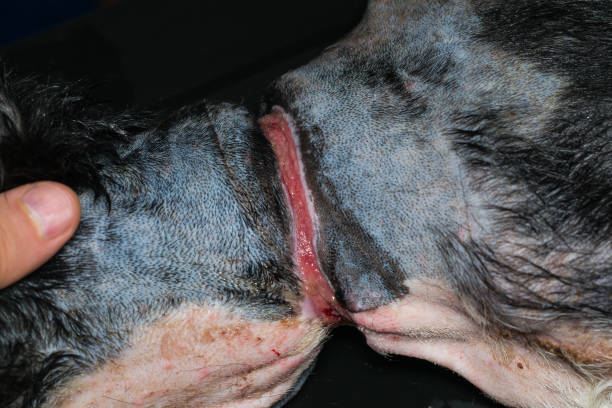
Severe laceration wound on a dog's neck, likely caused by a poorly fitted bark collar.

Life-or-death time management: How Long to Wear Bark Collar’s Golden Rule

Understanding the principles of necrosis allows us to comprehend why “time management” is the core principle of wearing a bark collar.

Many users searching for “how long to wear a bark collar” on forums hope to get a casual answer, but in reality, this number is a red line that cannot be crossed.

The 12-Hour Deadline

The industry-recognized limit for safe wearing time is: the total time spent wearing a bark collar each day should never exceed 12 hours.

Please note that this 12-hour limit is the “maximum tolerance threshold,” not a “recommended standard.”

Just like wearing a pair of tight-fitting dance shoes, no matter how well-fitting the shoes are, your feet will feel sore and swollen after 12 hours.

For a dog’s delicate neck skin, 12 hours is the limit to which capillaries can maintain their vitality under extreme pressure.

Once this time is exceeded, skin cells will begin to suffer irreversible damage due to ischemia.

Therefore, the best strategy is to only wear it during training or specific situations (such as mornings when barking is likely).

The 2-Hour Shift

Even within the legal 12-hour window, you cannot simply fasten the collar and leave it on.

Another crucial operating procedure is to fine-tune the receiver’s position every 1 to 2 hours.

This doesn’t require unfastening the collar; you simply need to gently move the receiver a few centimeters to the left, right, or up.

This simple action is like “releasing” skin that has been under pressure for a long time, allowing fresh blood to flow back to the area that was just compressed, carrying away metabolic waste.

This is the lowest-cost and most effective way to prevent pressure necrosis in dogs.


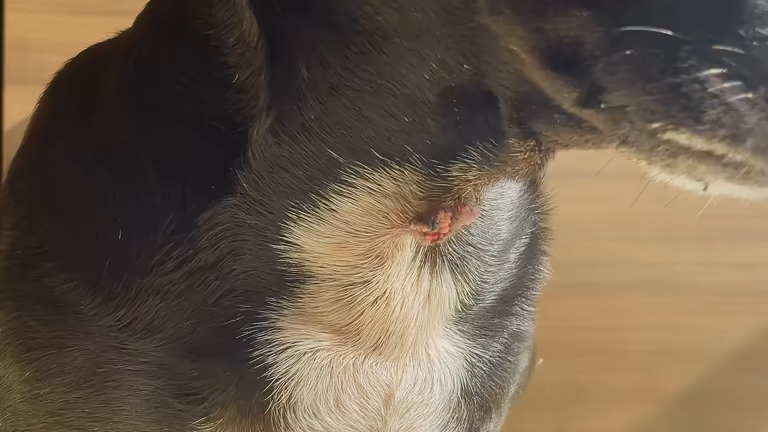
Small skin lesion on a dog's neck, potentially from prolonged wear of a bark collar.

Visible microscopic battlefield contact points and the skin’s cleansing defenses

Besides pressure, bacterial infection is the second leading cause of skin ulceration.

The contact points of a bark collar act as a breeding ground for microorganisms.

The metal probe scrapes against the dog’s neck every day, accumulating a large amount of dead skin cells, sebum, and environmental dust.

If left uncleaned for several days, these organic substances will form a layer of black grime at the bottom of the probe.

This not only reduces conductivity (causing the device to emit longer pulses to send signals), but the grime itself is a breeding ground for various bacteria (such as Staphylococcus).

Once the pressure dermatitis develops even a tiny ulcer, these bacteria can immediately take advantage of the weakened state, escalating ordinary erythema into severe purulent dermatitis.

Establish your daily defense process:

  • Device cleaning: Each time you remove the collar, carefully wipe the contact points and backplate with 75% medical alcohol wipes.
  • Dog body check: During the 12-hour non-wearing period (usually at night), touch the skin at the contact point with your fingers against the direction of the fur. If you find any signs of redness, immediately stop using the collar for a few days until the skin has completely recovered.
  • Regular grooming: For breeds prone to oiliness (such as Labradors), it is necessary to regularly wash the neck with antibacterial shampoo to keep the skin dry.

Evolution of hardware design to eliminate risks at the source

Besides adhering to wearing time and hygiene guidelines, we can also make smarter decisions when choosing tools.

Traditional solid stainless steel long probes, due to their rigidity and lack of flexibility, are most prone to causing localized pressure.

Now, technological advancements have provided us with physical compromises.

Responsible love is based on science.

A bark collar is a powerful behavior correction tool, but it’s by no means a “permanent accessory” that can be forgotten on a dog’s neck.

The 12-hour red line and the tedious operation of changing it every 2 hours test not the quality of the product itself, but the owner’s sense of responsibility.

Understanding the principles behind pressure necrosis dogs can free us from blind fear and allow us to approach training tools with a more scientific and rigorous attitude.

In the future, with advancements in wearable technology, we may see smart collars with built-in pressure sensors and blood oxygen monitoring, but until then, your hands and careful attention are the best protection for your dog’s skin.

Your hands and careful attention are the best protection for your dog’s skin.


FAQ

Why do these wounds look exactly like shock collar burns?

Shock collar burns are a highly misleading visual illusion.

When tissue undergoes “pressure necrosis,” dead skin cells peel away, exposing the underlying red, oozing dermis, often accompanied by hair loss.

This appearance is extremely similar to the rupture of blisters formed after a thermal burn.

The key to identification lies in the depth and location of the wound: pressure wounds are always perfectly aligned with the size of the contact point and are more often ulcerated than charred.

Can I let my dog wear a bark collar while he sleeps?

Absolutely not.

This is the biggest high-risk behavior that causes neck sores from the collar in dogs.

When dogs sleep, they not only remain in one position for extended periods, exacerbating localized pressure, but the risk also increases dramatically if the collar accidentally gets caught on bedding and tightens, especially when unsupervised.

Removing the collar every night is essential for allowing the skin to “breathe” and for capillary function to recover.

If my dog has developed neck sores from the collar, what should I do?

If you notice any redness, hair loss, or sores, here’s what you should do:

  • Immediately stop using any type of contact collar.
  • Do not attempt to cover it with a band-aid.
  • Mild redness may heal on its own within a few days.
  • If it has broken open and is oozing, seek immediate medical attention (VET), which usually requires the use of an antibiotic ointment (such as chlorhexidine) to control the infection.
  • Temporarily switch to sound training or positive reinforcement training until the skin has fully healed.

Leave a Reply

Your email address will not be published. Required fields are marked *