Imagine this scenario that sends chills down the spines of countless outdoor dog owners: On a sunny weekend, you’re hiking by a lake with your energetic Labrador. Suddenly, a waterbird skims the surface, and your dog, driven by instinct, leaps into the water without hesitation.

Your heart skips a beat, not because you’re worried about your dog’s safety, but because you suddenly realize that the bark collar it’s wearing might not be properly designed for diving.

A few seconds later, when you see the indicator light on the collar flashing wildly before going completely out, you know that your expensive equipment is now useless.

In the world of pet electronics, “waterproof” is one of the most misused marketing terms. As a product observer who has studied this field for a decade, I have often seen users pay a high price for trial and error because they confuse “splash-proof” with “diving-safe.”

If your dog is a hunting dog, a water retriever, or simply an active furry friend with a “muddy gene,” then an ordinary rainproof design is far from enough.

Today, we’ll peel back the layers of the specifications and delve into the truth behind IP protection ratings, showing you how to determine if a device can truly accompany your dog “in the air and in the water.”

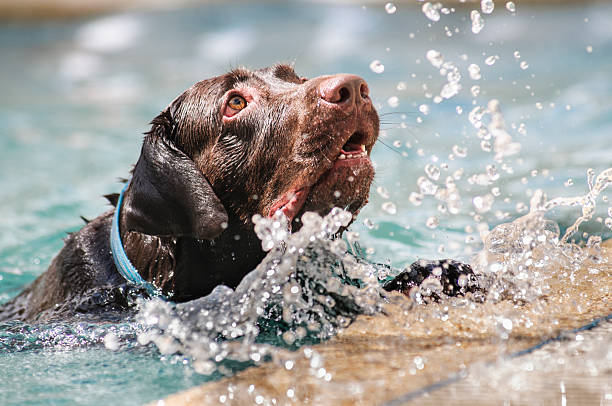
Energetic Labrador dog splashing happily in a pool. Consider a bark collar for training.

Decoding the true meaning of the business traps: IPX5 vs IPX7 vs IP67

When you open the product manual for a bark collar, you’ll usually see a code starting with “IP” in the specifications. This is the foreign object protection rating standard set by the International Electrotechnical Commission (IEC).

Many manufacturers deliberately blur the lines between these numbers, but for outdoor dog owners, every difference in these numbers can determine the life or death of the equipment underwater.

IPX5: The Limits of Rain Walkers

Many low-end collars on the market are labeled IPX5. The number “5” indicates that the device can withstand low-pressure water jets. In real-world scenarios, this means that it’s safe for dogs to wear it for a walk in a light drizzle or to be accidentally sprayed by a lawn sprinkler.

Fatal blind spot: IPX5 rating means the circuit board must never be submerged in water. Increased water pressure (such as when a dog jumps into a puddle) can cause water molecules to break through the seals instantly, leading to a short circuit on the circuit board.

IPX7: The True Watershed for Diving Grades

If you have a dog who loves to swim, an IPX7 bark collar is the bare minimum. The “7” represents a significant leap forward, meaning the device can withstand immersion in 1 meter of water for 30 minutes without leaking. This level of protection typically involves internal waterproofing or rigorous ultrasonic welding. For dogs that enjoy playing in shallow water or occasionally wading into streams, IPX7 provides an absolute barrier.

IP67: The Ultimate Armor of the Mudhound

For professional retrievers or working dogs, the environment often includes not only water but also mud and sand. The “6” in IP67 represents the highest level of dust-tight protection, meaning that even the finest particles of mud and sand cannot penetrate. If you frequently take your dog to muddy swamps or sandy riverbanks, an IP67-certified submersible dog collar is the truly indestructible choice.

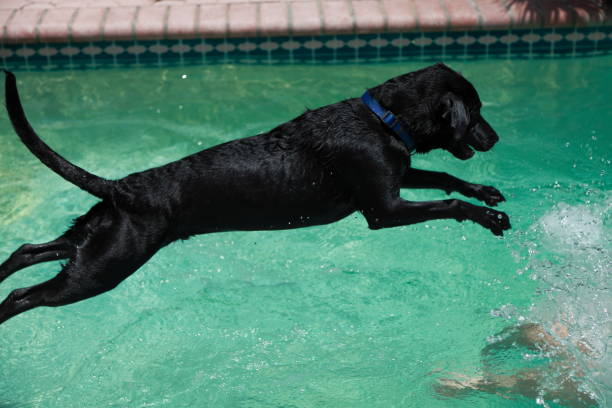
Black Labrador joyfully leaping into the swimming pool. A bark collar helps.

Structural analysis reveals the ultimate sealing defense customized for Waterdogs.

Knowing the specifications is only the first step. To assess whether a waterproof bark collar can withstand prolonged underwater use, you need to examine its physical structure like an engineer. Water is extremely permeable, and any opening in the equipment is a potential point of failure.

  • 1. The battle of charging ports: magnetic vs. rubber plugTraditional collars typically use a USB charging port with a rubber dust plug. This is the design most prone to failure. Over time, the rubber plug will age, deform, or simply be left in place due to the dog owner’s negligence, allowing water to seep in.Top-of-the-line water collars have all switched to magnetic charging. Because there are no physical ports, the entire casing is molded in one piece, fundamentally eliminating the possibility of water ingress.

  • 2. Housing assembly: Screw fastening vs. ultrasonic weldingYou can examine the back of the collar receiver. If you see screws, it means it’s sealed by an internal rubber ring. The risk with this design is that the violent vibrations from a dog running might loosen the screws, causing the seal to fail.Devices specifically designed for underwater use ultrasonic welding technology to completely fuse two pieces of plastic into one, forming an irreversible closed structure.


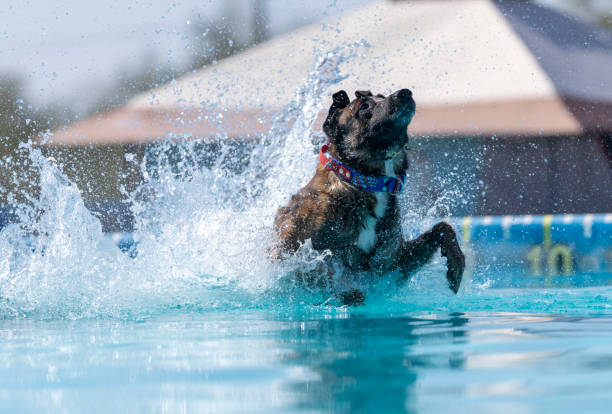
Brindle dog creates a huge splash in the pool. A bark collar aids behavior.

Underwater Conductivity Safety Warning: Potential Risks of Swimming with Shock Collar

Having solved the issue of device survival, we must now confront a more fundamental technical problem concerning the well-being of dogs: water is an excellent conductor of electricity. This simple physical fact introduces a crucial variable when swimming with a shock collar.

When a dog’s neck is fully submerged in water, the moisture fills the gaps between the metal contacts (prongs) and the skin. This significantly reduces the skin’s electrical resistance.

If you set the static electricity level to 3 on land, underwater, due to the surge in conductivity, the perceived stimulation could instantly reach 5 or even 6 levels. This sudden, intense stimulation can not only frighten a swimming dog but also potentially cause dangers such as choking on water.

Safety guidelines for experienced trainers:

  • Reduce static electricity intensity underwater: If you know your dog is about to go into the water, be sure to reduce the static electricity intensity by 1-2 levels in advance, or switch directly to a vibration/sound mode that is not sensitive to water.

  • Freshwater vs. Saltwater: Saltwater (seawater) is far more conductive than lake water (freshwater) and is extremely corrosive. The intensity decay strategies mentioned above are especially important if you are training at the beach.


Let technology adapt to human nature, rather than suppress it.

In this era of rapid technological advancement, excellent pet products should blend seamlessly into the natural environment like a chameleon, rather than become fragile burdens. For bark collars, waterproofing is not just a matter of specifications; it’s about the lifespan of the device and, more importantly, about the consistency and safety of training your dog in diverse environments.

Clearly define the IPX7 or IP67 standard, pay attention to magnetic charging and integrated sealed structure, and always keep in mind the safety principle of changing conductivity underwater. Only in this way can you truly unlock this technological key to carefree outdoor time with your beloved dog.


FAQ

Can I use an IPX7 bark collar in seawater?

In terms of waterproofing, IPX7 can prevent seawater intrusion. However, the salt in seawater is extremely corrosive to metal contacts. If an IPX7 bark collar is used in seawater, the entire device and charging contacts must be rinsed immediately with plenty of clean fresh water after getting ashore and thoroughly dried; otherwise, the contacts will rust within a few days, rendering the device unusable.

Why does the beeping sound from my dog’s collar become quieter after he/she swims?

This isn’t water damage to the device; rather, water droplets have clogged the buzzer’s sound output hole. Many submersible dog collars have a waterproof, breathable membrane inside the sound hole (allowing air but not water), but after immersion, this membrane can obstruct sound transmission. Simply shake the collar gently to dry it, or let it air dry naturally, and the sound intensity will return to normal.

What should you pay attention to besides lowering the gear when swimming with a shock collar?

Besides lowering the static electricity setting, it’s even more important to ensure the collar is snug. When dogs swim, their neck muscles stretch and contract dramatically. If the collar is too loose, the device may slip down to the chin or back of the neck due to water resistance, causing the contact points to become ineffective. Before entering the water, please recheck the tightness according to the standard of “only one finger can be inserted.”

Leave a Reply

Your email address will not be published. Required fields are marked *