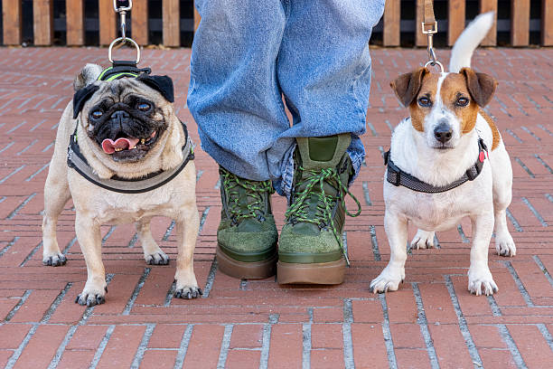
In the dead of night, the once quiet neighborhood was shattered by a series of rapid, intermittent barks. Those behind the windows grew restless, their phone screens lit up, and a familiar term popped up in the search bar— bark collar.
It always seems to be packaged as a “quick way to stop barking,” but truly experienced dog owners often pause before ordering: When should it actually be avoided?

This article isn’t about deciding “whether to buy,” but rather about providing boundary judgments regarding “whether it’s suitable to use.” By systematically outlining the prohibited scenarios, potential risks, and consequences of misuse of bark collars, it helps you avoid behavioral deterioration, damage to trust, and even long-term psychological impact caused by improper tool use.


puppy wearing bark collar during early training stage

Puppy stage: When behavior is not yet fully developed, bark collars may cause long-term side effects.

When searching for “is a bark collar safe for puppies,” many results don’t offer a clear “yes” or “no,” but rather a cautious evasion. This ambiguity itself is a signal.

A puppy’s barking is not necessarily a “problem behavior.”
More often, it’s a way of exploring the world:
a response to unfamiliar sounds, anxiety about separation, and an immediate reaction to stimulating environments.

The problem is that the bark collar works on a “disruption-inhibition” logic. When this mechanism intervenes too early, the puppy may not have developed a “cause-effect understanding” and will only perceive an unpredictable stimulus. In behavioral science, this is called irrelevant punishment.

Some canine behavior studies indicate that puppies aged 8–12 weeks are in a critical socialization window. Negative stimuli received during this stage may be incorrectly associated with the environment, people, or their own behavior, rather than with the act of barking itself.
The result is often not quietness, but rather

  • Be more vigilant about the environment
  • Avoidance or fear of sound
  • Barking decreased, but vicarious stress behaviors increased (biting, circling, licking).

Therefore, in the puppy stage, the answer to “when not to use a bark collar” is usually very clear: inhibitory tools should not be used before the behavior is clearly defined.


Anxious dogs: Stopping barking doesn’t reduce stress; it may actually amplify the root of the problem.

Not all barking stems from “excess energy.”
For dogs experiencing separation anxiety, noise sensitivity, or trauma, barking is a form of self-regulation.

In these scenarios, the risks posed by bark collars are particularly prominent.

Imagine a typical scenario:
A dog barks incessantly due to separation anxiety, and a collar intervenes every time it makes a sound. On the surface, the barking frequency decreases; however, the anxiety itself hasn’t disappeared—it has simply lost its outlet.

Multiple behavioral counseling cases show that these types of dogs may exhibit the following behaviors:

  • Anxiety shift (from barking to destructive behavior)
  • Heart rate remained elevated, but behavioral overtness decreased.
  • Some people have a resistance or even fear of wearing collars.

.This is why anxious dogs are consistently listed as a high-risk group in discussions about bark collar risks .

The real problem isn’t the “voice,” but the “emotion.”
When tools only target the surface, stress accumulates within the system.

problem butIn this situation, a bark collar not only fails to solve the problem, but may also become a trigger for a breakdown in trust.


anxious dog reacting to bark collar indoors

Contraindications for use in specific health conditions: overlooked physiological risks

When discussing bark collars, health factors are often relegated to a secondary position, but from a professional veterinarian’s perspective, they are precisely the key variables.

The following types of dogs are generally advised to avoid using any form of anti-bark collar:

  • Dogs with a history of tracheal collapse or respiratory allergies
  • Individuals with cardiovascular dysfunction or unstable heart rate
  • Skin prone to allergies, old neck injuries or surgical history
  • History of neurological disorders or epilepsy

barking butEven non-electrically stimulated collars, due to their weight, placement, and continuous contact, can cause discomfort with prolonged use.
Some users have reported that they initially intended to reduce barking, but ended up having to stop using them due to skin redness and abrasions.

In these cases, “barking suppression efficiency” should never be the basis for decision-making in the first place.
Health should be the priority, and this is the premise for all behavioral interventions.


Misjudging barking motives: the most common and costly mistake

.Many disputes over its use stem not from the tool itself, but from misjudging the reason for the barking .

Alert barking, demand barking, fear barking, and playful barking may seem similar, but their triggering mechanisms are completely different.
When bark collars are applied uniformly to these differentiated behaviors, problems are almost inevitable.

A common user experience is this:
“It works at first, but after a few weeks, it gets worse.”

quiet”;The reason is that the dogs haven’t learned “when to be quiet,” they’ve only learned “the environment is no longer safe.”
As a result, barking decreases, but anxiety increases.

ButIn the world of garage tools or home appliances, misuse may simply mean reduced efficiency;
but in behavioral interventions, misuse means relational costs.


veterinarian examining dog neck before bark collar use

The true meaning of using boundaries: not prohibition, but restraint.

.Discussing “when not to use a bark collar” does not equate to denying its value.
Truly mature discussions often focus on boundary management .

The following signals usually indicate that use should be paused or reassessed:

  • The frequency of barking has decreased, but the dog’s overall condition has become more tense.
  • exhibiting clear avoidance behavior towards collar
  • New stress-related behaviors emerge
  • Family members disagree on how to use it.

When these signs appear, continuing to rely on tools often only amplifies the problem.


Quietness is not the only indicator; relationships are the key to long-term returns.

areOne of the most easily overlooked points in
All the discussions about bark collars is that reduced barking does not automatically equate to the problem being solved.

IsWhat truly needs to be evaluated is the dog’s state after it calms down—
is it relaxed or repressed?
Is trust still there, or has the relationship developed a rift?

Perhaps, the next time the search box shows “when not to use bark collar,” the answer will no longer be a specific scenario but rather the ability to make judgments.

Tools can wait, but relationships cannot be rebuilt.

Leave a Reply

Your email address will not be published. Required fields are marked *