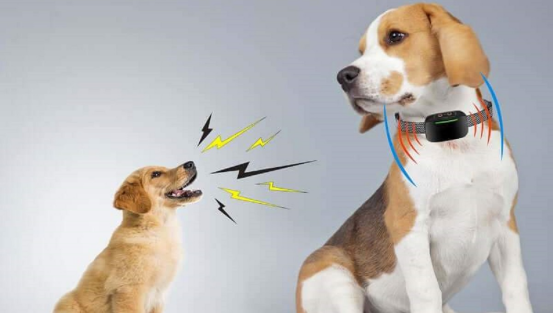
,Sometimes, a dog’s barking isn’t a sudden outburst of emotion, but rather like a repeatedly triggered nerve that snaps at the slightest touch. The more you yell, the more excited it gets; the more you soothe it, the more it barks. Many owners then turn to bark collars for training but worry that they might make training rigid.
But the amazing thing is, truly effective training often doesn’t rely solely on tools or commands but rather on the interplay of both , like two gears—one providing a steady rhythm, the other providing the power—to drive genuine behavioral change.

SomeoneBefore discussing bark collars, imagine this moment:
someone walks by downstairs at night, and the dog suddenly tenses, strains its throat, and takes a step forward, like a taut string. You instinctively want to stop it, but your voice is always a beat behind the dog’s bark.
It is in this frustration of always being a beat behind that the combination of bark collars and behavior training begins to seem more like a realistic solution than a substitute.

Next, let’s break down the common misconceptions, training points, and psychological mechanisms and go through a truly sustainable barking behavior modification process from beginning to end.


Dog responding to a bark collar after a trigger

Training begins with “rhythm,” not with tools.

The first mistake most owners make is making the bark collar the main focus.
But the training principle is always action—feedback—reinforcement.
The collar is just one form of “instant feedback,” not the whole picture.

To truly stabilize the training system, three basic rhythms must first be established:

1. Environment-triggered prediction training

For example, the appearance of a mailman, the sound of unfamiliar footsteps, or the sound of an elevator.
When a dog hears these stimuli, its body leans slightly forward; this moment can be the entry point for behavioral training.
Industry research often mentions:

Dogs will exhibit observable muscle preparation 0.5–1 seconds before the trigger point.

the collarIf you can provide instructions during this period (such as sit, hand target”), the training tool will have room to intervene; otherwise, Collar will only provide feedback “too late.”

2. Establish vicarious reinforcement for quiet behavior.

To prevent a dog from barking, you need to teach it “which behaviors are worth reinforcing.”
For example:

  • Near the door but keep quiet
  • Hearing the sound, but turning his attention to his owner
  • After a brief period of alertness to stimuli, one can return to the resting point.

These can all be incorporated into a reward mechanism using the principles of dog obedience training.

3. Integrating training into daily life

lesson butTraining isn’t a 10-minute lesson, but rather the invisible fragments of life.
For example:

  • cooking.Someone knocks on the door while you’re cooking → Guide your dog to sit quietly and wait.
  • command and reinforceHearing a knock on the neighbor’s door at night → Use a soft voice command + reinforce calming

When your rhythmic commands are naturally absorbed into your life, the bark collar can then serve as an “auxiliary beat.”


Dog wearing a bark collar during training session

tagger.”The bark collar is not a replacement for training but rather an “instant tagger”.

likeDiscussions about bark collars in the market are often simplified to a binary choice of “effective/ineffective,” but from a professional training perspective, it’s more like:

A device that automatically marks barking behavior before you even have a chance to speak.

You might be surprised to learn that many professional trainers consider the bark collar to be:

  • Provide a negative cue at the moment of barking.
  • outcome.”Help dogs understand that “barking = unexpected outcome”.
  • The training process is independent of the owner’s position and reaction speed.

“immediacy.”Most importantly, it solves the problem of time difference —
Humans can never react faster than dogs, and the success of behavior training depends almost entirely on “immediacy”.

punishment butBut note: immediacy is not a punishment, but a marker.

rigid butOnce this principle is understood, tools will not make training rigid, but rather make the process clearer, more stable, and more consistent.


Owner using positive reinforcement in dog training

Breakdown of the actual process of behavioral training + bark collar

To make the content more relevant to real-world experience, I’ve combined trainer case studies, user feedback, and common methods from dog obedience training courses to create a more practical process.

recommendations butThe following does not involve product recommendations, but only focuses on the training logic:


Step 1: Help the dog understand that “barking = being marked,” rather than “barking = danger.”

When dogs first start using a bark collar, they typically exhibit three reactions:

  • A noticeable pause after barking
  • After barking, it turns around to look for the source.
  • Try barking continuously after it has started (usually for the first 1–2 days).

These are all natural reactions, and there’s no need to interrupt them.

Your only task is
to give it a reinforcement or calming command the moment it stops barking.

; don’tThe purpose of this step is to tell the dog:
“Stop, and you will be rewarded, not bark and make it more nervous.”


Step 2: Incorporating Alternative Behavior Structures

If training remains at the “stop barking” stage, it’s difficult to achieve behavioral stability.
For behavior modification to be truly sustainable, alternative behaviors must be introduced, such as:

  • Hearing the doorbell → Returning to the mat
  • Upon hearing footsteps, maintain eye contact with the owner.
  • :Nighttime noise → Choose to go back to your nest instead of rushing to the door

These are the core techniques of barking behavior modification.

Dogs don’t bark because they dislike stimulation, but because:

  • vigilance instinct
  • Lack of alternative decision-making
  • Habitual patterns
  • The owner’s reaction reinforced the behavior.

With alternative behaviors, the effectiveness of bark collars will significantly decrease, and they may even gradually become unnecessary.


Step 3: Move the training into the “delayed trigger” phase

Many pet owners believe that training is a one-time solution, but the real challenge is “delayed triggering.”

Maintain a few more seconds of thinking time after the trigger source appears.

For example:

  • Upon hearing footsteps, look at its owner for one second before making a decision.
  • After the doorbell rings, pause before deciding whether to go to the door.
  • If you hear noise at night, smell it first before reacting.

At this stage, bark collar intervention usually decreases as the dog begins to develop self-control.

This is where the true value of dog training tools like the bark collar lies: not in replacing decisions, but in helping dogs establish “judgment space.”


Common Misconceptions Deconstructed: Why Some Training Sessions Fail

To help you avoid the most common pitfalls in the industry, I’ve compiled a list of issues that repeatedly arise in the experiences of trainers and users.


Myth 1: Relying solely on bark collars while ignoring behavioral structure

Tools can only label behaviors, not provide alternatives.
Without a training framework, a dog will only remain quiet temporarily, without truly understanding “when to stop and why to stop.”


Myth 2: Feeling tense during use can actually exacerbate the dog’s anxiety.

A dog’s eyesight is sharper than you might think.
Your gestures, footsteps, and facial expressions directly influence its judgment.
An emotionally tense owner often excites the dog more, while the effectiveness of tools decreases.


Myth 3: Skipping “Pre-Trigger Training”

Many trainers emphasize:

Correcting barking behavior relies 70% on early intervention.

If you only interact with the dog after it has already barked, the training will never keep up.


—HopingMyth 4: False Expectations – Hoping to change habits in three days

The truth is:

  • Initial understanding period: 2–5 days
  • Behavioral stabilization period: 1–3 weeks
  • Model solidification period: 1–3 months

Training is cumulative, not switching.


Methods to make training more “life-like”

To enhance the practicality of the training, this section incorporates real-life pet owner experiences and behavior modification cases, along with some more relatable methods:


Involve your dog in your daily routine

Cooking, washing clothes, opening doors, watering plants… the more scenarios are added to the training, the more stable the pattern of “noise = task” becomes.


It’s easier to practice concentration while walking than indoors.

Outdoor noise can actually increase training opportunities and relieve stress.
Many trainers recommend incorporating response training into walks, allowing dogs to understand trigger mechanisms in their natural environment.


tasks.”tasks.”Give the dog some “meaningless tasks”.

For example, ask it to move a toy to a designated location.
These tasks require it to think, and thinking can significantly reduce the frequency of random barking.


substitution but substitution butTraining is not about substitution, but about ensemble playing.

TheThe relationship between bark collars and behavioral training is never about “who is stronger.”
It’s more like a chorus—
the tool provides the rhythm, the training provides the melody, and your daily routine determines the mood of the whole piece.

reflex but When barking is no longer an automatic reflex but an understandable and manageable behavior, you will find that the dog world becomes more stable and orderly.

Read more about the logic behind bark collar behavioral training.

Leave a Reply

Your email address will not be published. Required fields are marked *