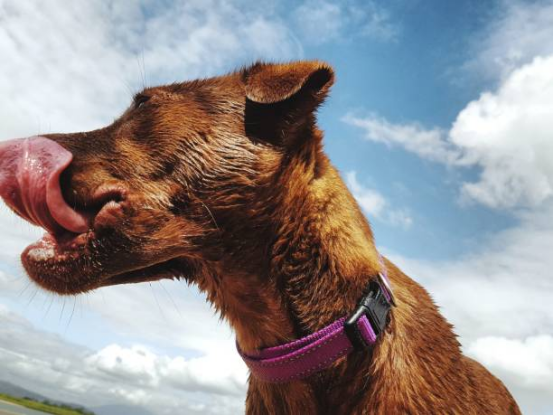
Much of what is said about barking control implicitly assumes that
The dog is not yet “fully developed.”

However, the reality is that more and more families trying bark collars are dealing with adult dogs that are three, five, or even seven or eight years old. Their behavior has already undergone years of repetition, and the established patterns have been firmly established. At this point, discussing training takes on a completely different context.

The problem of barking in adult dogs is rarely due to “incorrect methods,” but more often due to misaligned expectations. Applying training logic from puppyhood directly to adult dogs is the starting point for many frustrations.


Behind the barking of adult dogs lies a system that has been enhanced.

Barking in adult dogs is rarely caused by a single factor.

In the long run, adult dogs’ barking almost always goes through an “effective feedback” stage:
After barking, the stimulus disappears.
After barking, the owner appears.
After barking, the emotion is released.

Even if these results no longer exist today, the brain still remembers that path.

From the perspective of behavior modification, this type of behavior has several distinct characteristics:

  • Mature path: It can be executed automatically without relearning.
  • Emotional binding: not just behavior, but also a regulatory method
  • Highly resistant to interference: External changes are unlikely to immediately alter the results.

What does this mean?
It means that barking in adult dogs is not a “bad habit” but a strategy that has been repeatedly proven.


Adult dog wearing a Bark Collar during behavior intervention

What can and can’t a bark collar for adult dogs do?

When bark collars are introduced into adult dog training, their true purpose must be placed in the right position.

In practice, its most common effect is not “eliminating barking,” but rather reducing the frequency of the behavior.
The barking is less rapid, less prolonged, and less continuous.

This is actually a significant change, but it is often overlooked.

In real-world user experience, common feedback includes:

  • The barking still occurs, but it is more easily interrupted.
  • Effective for some triggers, but with limited response to long-term stimuli.
  • Performance decreases in complex environments.

These phenomena are not failures but rather expose the limitations of the bark collar:
It can intervene in the moment a behavior occurs, but it cannot rewrite the internal logic formed over many years.

If you expect it to be like a “reset button,” reality will almost certainly disappoint you.


The risks of improper use in adult dogs are more insidious.

When discussing risks, people often focus only on the intensity or method but ignore the mismatch between the stage and the risk itself.

In adult dogs, the most common risk of misusing a bark collar is not physical, but behavioral deviation.

For example:

  • The barking is suppressed, but the anxiety is released in other ways.
  • Over-reliance on collars leads to a rebound effect once removed.
  • Dogs learn “when it’s okay to bark,” not “how not to bark.”

These results all essentially point to the same problem:
Devices have replaced learning.

In the context of bark collars for adult dogs, without simultaneous behavioral guidance, the device can easily turn from an “intervention tool” into a “crutch.”


Diagram showing reinforced barking patterns in adult dogs

Why do adult dogs change more slowly but are more worth waiting for?

One easily underestimated fact is that
Adult dogs are actually more stable once they have completed their transformation.

Unlike puppies, adult dogs learn not through novel stimuli but through repetition, safety, and predictability. This is why the changes may seem slow, but they are more solid.

In some long-term cases, the following process can be observed:

  • Initially, the only goal is to reduce the intensity of the burst.
  • Hesitation and stagnation occurred in the middle stage.
  • The frequency only decreases in the later stages.

This order, which often contradicts intuition, is more in line with the laws of neurobehavioral response.

In these processes, the bark collar typically only exists in the initial stages, serving to weaken old reflections and make room for new ones.

Learn more about the bark collar analysis.


The most important thing to adjust in adult dog training is expectation.

The biggest challenge for adult dogs using bark collars is not actually for the dog but for the owner.

Much frustration stems not from “no effect,” but from “no immediate results.”
However, behavioral modification in reality is not an instant feedback system.

A more realistic expectation is often like this:

  • It’s not that it doesn’t cry out at all, but rather that it’s more controllable.
  • It’s not a one-time solution but a phased improvement.
  • It’s not about equipment; it’s about overall collaboration.

When expectations shift from “immediate results” to “gradual stabilization,” the training experience itself changes.


Owner observing adult dog hesitation before barking with Bark Collar

Returning to a more honest standard of judgment

In the context of adult dog training, perhaps we can ask a different question:

If bark collars weren’t available today, would you have seen a change in behavior?

Even small changes—
one more pause,
one less outburst,
one faster recovery.

These are the signs of real progress.

The real challenge of using bark collars on adult dogs has never been “whether they can be used,” but rather “how to avoid being tied up by them.”
Change truly begins when tools are no longer the only answer.

Leave a Reply

Your email address will not be published. Required fields are marked *