Some training tools, because they are “quick to show results,” are easily mistaken for “complete solutions.”
The bark collar is one such example.

In many discussions, it’s described as a device that can “automatically correct barking”: wear it, problems decrease, and the world becomes quiet. But once you actually enter a canine behavior training system, you quickly discover a fact—reducing behavior does not equate to completing learning.
And learning is precisely the core of training.

This article does not discuss model selection, compare models, or endorse any product. It attempts to break down the capabilities of the bark collar from the perspective of training systems and behavioral learning stages, explaining which key training aspects must be accomplished through environmental management and human-dog interaction, rather than relying on any tools.


The essential function of a bark collar is not “teaching.”

From a technical perspective, most bark collars operate on a highly consistent logic:
recognize barking → provide immediate feedback → reduce the frequency of the behavior.

This mechanism is not unfamiliar in behavioral science; it belongs to outcome-related feedback. Its advantages lie in its speed and consistency, and it is indeed effective in certain high-frequency, unconscious barking scenarios (such as those induced by environmental noise).

But the problem is that
Feedback ≠ understanding.

In dog training fundamentals, behavioral learning comprises at least three levels:

  • The behavior was interrupted
  • The cause of the behavior was replaced
  • Behavior is given new meaning

The bark collar can only reliably complete the first step.

Many trainers have repeatedly mentioned a phenomenon in practice:

The barking has decreased, but the dog’s tension, alertness, or anxiety has not disappeared; it has simply taken on a different form.

This is precisely the core of the limitations of the bark collar. It deals with “surface behavior” rather than “behavioral motivation.”


Before learning can take place, the environment must be prepared.

In real-world training scenarios, a fact that is often overlooked is that
Most problematic barking is primarily an environmental issue, not a problem with the dog itself.

Common triggers include:

  • Excessive exposure of the field of vision (pedestrians and vehicles outside the window)
  • Unpredictable sounds (elevator, hallway, doorbell)
  • Disordered sleep patterns (spending long periods alone, lack of physical activity)
  • The spatial boundaries are unclear (lack of a safe zone).

Before these conditions were adjusted, even with a bark collar, the barking was only “dulled out,” not truly eliminated.
Many users reported that the behavior would quickly rebound, or even become more intense, after the collar was removed.

This is not a problem of “depending on tools,” but rather that learning has not yet occurred.

In behavioral learning stages, environmental management is a prerequisite.
If this stage is missing, any subsequent intervention will become unstable.


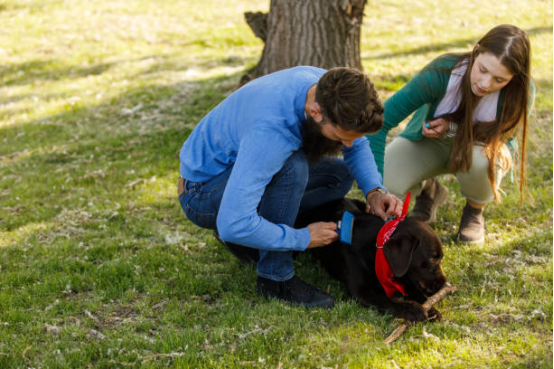
Dog wearing a bark collar while receiving human guidance

Human guidance is indispensable in the “alternative behavior” stage.

Truly effective training is not about stopping a certain action but about teaching a dog what else it can do in the same situation.

Here’s an example often cited by trainers:

When there are footsteps outside the door

  • Barking is a natural response
  • However, this can be replaced with returning to the cushion, sitting down, and looking at the owner.

This process requires three elements:

  • Clear behavioral goals
  • Repeated and consistent guidance
  • Positive feedback linked to results

The problem here is that
The bark collar cannot provide any “alternative behavior instructions.”

It doesn’t tell the dog “what to do”; it only hints, “Don’t do that.”
In a behavioral learning system, this is considered incomplete feedback.

Many professional training courses emphasize:

Without the inhibition of alternative behaviors, it will eventually fail.

This is why, in high-quality training cases, the bark collar is usually regarded as an auxiliary layer rather than a core training tool.


Trainer demonstrating alternative behaviors with a bark collar

The degree of reliance on tools varies at different learning stages.

Breaking down the training process into stages helps in understanding the applicability boundaries of the tool.

A simplified but practical way to divide it is:

  • Initiation phase: The dog has not yet understood the rules.
  • Construction phase: Behavior is being shaped
  • : Stable period: Behavioral patterns have been formed

During the initiation phase, dogs are highly sensitive to environmental and human feedback.
At this stage, relying primarily on the bark collar can lead dogs to associate discomfort with random environmental elements rather than specific behaviors.

During the construction phase, alternative behaviors are emerging.
At this time, any automation tools should be introduced with caution to avoid interfering with the learning path.

..Once things stabilize, some trainers will introduce bark collars in specific scenarios to reduce occasional regression behavior .
Even so, it remains supplementary, not the main focus.

. .From this perspective, the limitations of the bark collar are not a flaw but rather a problem of role positioning .


“Misjudgment signals” that recur in user experience

Several signals warrant attention amidst the numerous public training forums and user sharing sessions:

  • Barking has decreased, but the dog is pacing or licking its mouth more frequently.
  • More nervous response to normally neutral stimuli
  • a collar, a collar,Without collar, the behavior rebounds rapidly.
  • Decreased attention to owner’s commands

A key A keyThese do not necessarily mean that the tool is “harmful,” but rather that
a key element is missing from the learning system.

Truly mature training feedback should manifest as follows:

  • While the behavior decreased, the dog’s overall state became more relaxed.
  • Maintain consistency across different environments
  • More responsive to human commands

If the results do not conform to these characteristics, the problem is often not with the tool itself, but with the logic of its use.


Diagram showing bark collar role in behavioral learning stages

Why is “training systems thinking” more important than tools?

equipment. But within the industry, a growing consensus is emerging:
Training is not about stacking equipment but about system design.

A complete system includes at least:

  • Environmental structure
  • Time Management
  • Human guidance
  • Behavioral feedback path

The bark collar only covers a very small segment of the path.
When it is magnified in isolation, training is more likely to go astray.

Some trainers suggest that trainees learn behavioral shaping logic systematically after understanding how the bark collar works.


The place where tools fall silent is where training truly begins.

Training doesn’t end when the barking stops.
On the contrary, that’s when learning can truly begin.

Understanding: The bark collar reveals the fact
That behavior can be interrupted.
But it also reminds us that
Understanding, choosing, and substituting can never be automated.

Learn more about bark collars.

Leave a Reply

Your email address will not be published. Required fields are marked *