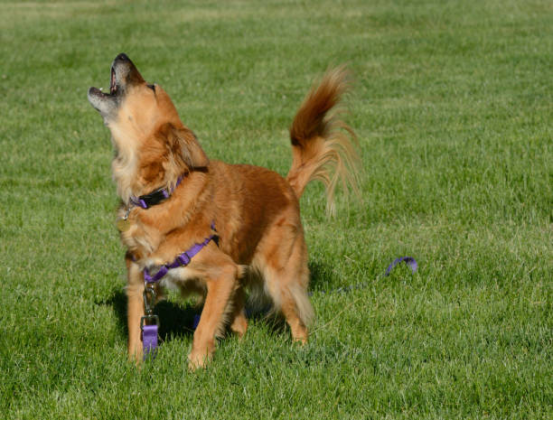
Before the sound even appears, the body often reacts first.
Ears flatten, tail slightly droops, and breathing becomes rapid. The barking is just the last part to surface. In many households, the bark collar is put on in this “already tense” state. The question then arises: when a correction tool intervenes in a behavior already driven by emotion, does it reduce the problem, or does it subtly alter the dog’s understanding of the world?

The online debate surrounding whether bark collars trigger fear responses remains divided. This article will begin by examining the formation mechanism of fear-based barking, analyzing how the bark collar fear response is amplified, identifying common dog training mistakes, and providing feasible prevention and correction strategies to help readers re-examine this tool from the perspective of long-term behavior shaping.


Dog showing early fear signals while wearing a bark collar

Fear doesn’t begin with stimulation but with “unpredictability.”

In behavioral science, fear does not simply stem from the intensity of the stimulus but rather from whether the stimulus is predictable and understandable.
When dogs cannot accurately judge “what behavior will lead to what consequences,” their stress levels rise rapidly.

This is why fear-based barking often occurs in specific scenarios: doorbells, strangers approaching, or sudden noises outside the window. These are not random events but rather stimuli that have not yet given the dog a stable coping strategy.

The problem is that bark collar intervention often occurs after the behavior has already begun. Barking, tension, and scanning the environment form a coherent chain of emotional responses. When a stimulus appears in the middle of this chain without being clearly “interpreted,” the dog tends to associate the discomfort with the environment as a whole, rather than with the specific behavior.

Several canine behaviorists have pointed out in published articles that this is one of the key pathways in the formation of the bark collar fear response:
The stimulus is not understood as a “causal result” but rather perceived as “part of an environmental threat.”


How misuse amplifies fear learning: from correction to generalization

reversibility. Ideally, any behavioral intervention should possess three elements: clarity, immediacy, and reversibility. However, in real-world use, bark collars often deviate from this model.

The most common dog training mistakes are not due to “using tools,” but rather a combination of the following situations:

  • Intervene when the dog is already in a state of high alert or fear.
  • Wearing it all day long can cause stimulation that lacks boundaries.
  • Treating barking as the problem itself, while ignoring the trigger.

When these factors combine, learning “generalizes.”
The stimulus that was originally directed at the barking gradually spreads to the entire scene: the doorway, the window, and even the quiet of the night itself.

case but Some long-time users on the forum mentioned that after their dogs stopped barking, they exhibited changes such as avoiding specific areas and becoming overly sensitive to everyday sounds. This is not an isolated case but rather a natural result of the continuous reinforcement of fear learning.

It is worth noting that these changes usually do not appear immediately. Fear responses tend to accumulate slowly; they are not as easily detected as barking, but they are more persistent.


Bark collar being adjusted to prevent stress in a dog

Bark collars exhibit different behaviors in dogs with different personalities.

When discussing whether a bark collar will trigger a fear response, individual differences cannot be ignored.

Behavioral studies generally suggest that highly sensitive dogs with low thresholds are more likely to develop defensive responses to uncertain stimuli. These dogs are naturally inclined to use barking to establish a sense of distance. Once the barking is interrupted and no new coping mechanisms are established, the emotional stress is internalized.

In contrast, dogs with higher neurological stability and more predictable living environments may only exhibit short-term inhibition and may not necessarily develop obvious fear-based barking.

However, there is a risk that is easily overlooked:
“The absence of immediate problems” does not mean that “no learning has occurred.”

Over time, some dogs have gradually come to associate the presence of the bark collar with environmental anxiety, rather than with their own behavior. This implicit association often only becomes apparent after the tool is removed.


Recognizing early signals is more important than barking.

If fear responses do not always manifest as barking, then the criteria for judgment must be moved forward.

Behavioral consultants often recommend paying attention to the following changes:

  • Slowing down or hesitating when entering a specific area
  • Stop the current activity upon hearing the slightest sound.
  • Barking decreased, but lip licking, yawning, and avoiding eye contact increased.

These signals aren’t “noisy,” but they are evidence that the stress system is still being activated.
In many bark collar-related cases, it is precisely these details that are overlooked, leading to the problem being misjudged as “resolved.”

Understanding this helps us move beyond the simplistic evaluation system of “quiet = success” and makes it easier to correct dog training mistakes in advance.


Dog hesitating near doorway, illustrating fear response from bark collar misuse

The core logic of prevention and correction is to rebuild a sense of control.

Truly effective prevention strategies are not complicated, but they need to be in the right direction.

First, reduce unpredictability.
Any stimulus should be associated with a specific situation as much as possible to avoid adding new discomfort to a highly emotional moment.

Second, distinguish between “management” and “learning.”
If a bark collar is viewed as a temporary management tool, its risks are far lower than if it’s considered a long-term solution. Learning must be accompanied by the establishment of alternative behaviors, not simply unilateral suppression.

Third, prioritize correcting environmental triggers.
Fear-based barking often stems from external stimuli rather than the barking itself. When environmental stress decreases, the behavior will naturally change.

In summaries of some behavioral training cases, a common point can be seen:
When dogs regain a sense of control over their environment, their fear response decreases significantly, even if a bark collar has been used before.

If you wish to gain a deeper understanding of the relationship between fear learning and tool intervention, you can read this analysis of the bark collar behavioral response mechanism to help you examine the issue from a more macro perspective.


Returning to the core question, what exactly are we changing?

Does a bark collar always trigger a fear response? The answer is not absolute.
But what is certain is that, when misused, relied upon for a long time, or its emotional context is ignored, it does carry the risk of amplifying fear learning.

world. Perhaps a more important question than “whether or not to use it” is
When a dog stops barking, is its body truly relaxed?
When the environment quiets down, does it understand the world or simply learn to endure?

Fear never appears suddenly. It takes shape slowly in the details that are often overlooked.
Understanding this may be the true starting point for making rational long-term decisions.

Learn more about useful information about bark collars.

Leave a Reply

Your email address will not be published. Required fields are marked *